Why AI-Generated Job Applications Are Slowing Down Hiring (And What Actually Helps)
By Dusan Boljevic · AI/ML Engineer at TheChecker.AI
Quick answer
Hiring is getting slower, not faster, because of AI. Robert Half's November 2025 survey of more than 2,000 U.S. hiring managers found that 67% say reviewing AI-generated applications has slowed their hiring process, and 20% report delays of more than two weeks. The cause isn't just volume. It's that a well-written, keyword-matched application no longer tells a recruiter anything reliable about the person behind it. Adding more screening steps doesn't fix that gap — verifying what's actually in front of you does, and detection is one fast way to start.
The volume problem is real, and it's getting worse
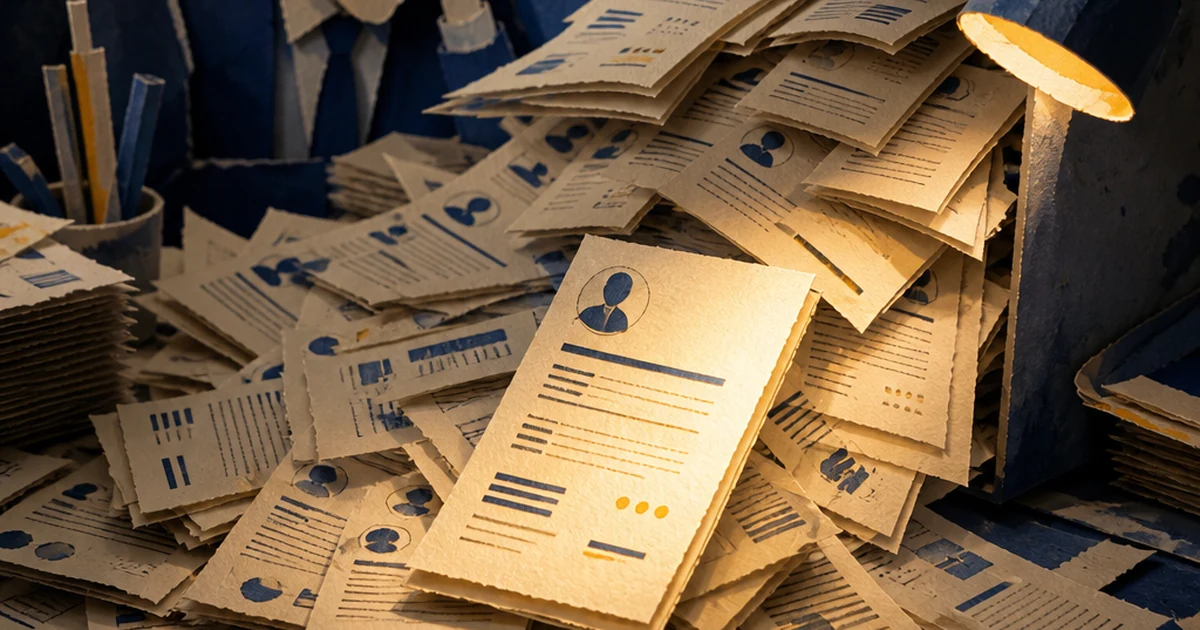
Job seekers have long been told to apply widely. AI has made that advice free to act on at scale. LinkedIn reported an average of 11,000 applications submitted per minute on its platform, per reporting picked up by outlets including eWeek. LinkedIn's application volume jumped roughly 45% year over year, and generative AI tools are a major driver of that surge. Onehour Digital's 2026 compilation of hiring-platform data found applications per hire tripled between 2021 and 2024, and the average corporate job posting now draws around 250 resumes for four to six interview slots and one hire.
Artificial intelligence accelerates the creation of job-application materials for seekers. Autofill utilities like Simplify's Copilot cut down the time it takes to complete identical sections on different company sites. There exist bots that run automatically, for example, LazyApply, Sonara, and comparable solutions, that push generic resumes to a wide array of job postings without tailored edits. When a recruiter reviews an application, the origin of the submission remains invisible.
Recruiters are adding steps, not confidence
The Robert Half survey measured the slowdown. It also examined what HR teams are doing about that slowdown. None of the actions taken by HR teams are fast.
Recruitment processes are being reshaped across the corporate sector. More time for each application is now allocated by forty-two percent of companies. The number of interviews per candidate goes up for thirty-eight percent of employers. Job descriptions are being updated by thirty-two percent of firms to filter out generic AI-generated replies.
Eighty-four percent of HR leaders say their teams' workload has grown as a direct result. And 65% say a surge in AI-enhanced applications has made it harder to verify whether a candidate's stated skills are real — not because AI-written text is inherently deceptive, but because the same tools that help an honest candidate polish a resume also let a dishonest one fabricate one. Robert Half is explicit about this in its own reporting: not all AI-generated applications are inaccurate or misleading, and plenty of candidates use AI responsibly to fix grammar or tighten phrasing. The problem is that from the outside, a well-edited truthful resume and a well-edited fabricated one currently look identical.
That's the gap we've covered from the job-seeker side before: most hiring managers say they can spot AI-written material on sight, but no independent study has actually tested that confidence against a known-answer set the way academic detector-accuracy research does for text detectors. Self-reported "I can usually tell" and a validated detection rate are two very different claims, and right now the hiring side is running almost entirely on the first one.
Why more interviews doesn't solve the actual problem
Adding a second or third interview round eventually catches some of the mismatch. Robert Half advises hiring managers to use behavioral questions, work simulations and reference checks that go beyond simple title-and-date verification. Those practices are good and effective, yet they are expensive. Moreover, they happen too late in the funnel to explain why review time has risen by 42% and why the number of interviews has jumped by 38%. The real driver of both delays and interview counts is the initial sort, where a recruiter decides which of 250 similar-looking applications deserves a human's time.
This is the same dynamic Wharton economist Judd Kessler describes for cover letters specifically: once everyone can produce a polished, tailored application in ninety seconds, a polished, tailored application stops being a useful signal on its own, because it no longer separates the motivated candidate from the one who ran a template through a chatbot. A Freelancer.com field study covering more than five million cover-letter submissions found that once an AI drafting tool became available on the platform, the correlation between cover-letter quality and getting hired fell by 79%. Employers didn't get better at catching AI text. They stopped trusting the letter and leaned on other signals instead.
Detection serves as a tool, not a replacement for behavioral interviews or reference checks. It merely moves the valuable part of scrutiny forward to the cheapest point: before a candidate spends forty-five minutes on a screening call with an application that is just an unedited chatbot output pasted into a form field. A text-level AI-content score does not prove a lie. The AI-content score functions as a signal, similar to the cues academic-integrity teams rely on. The signal tells you to examine a particular answer more closely; it does not, by itself, justify any decision.
What actually helps, in order
- Triage with a detection score before the interview stage, not after. Run a cover letter or long-form application answer through a free check — try it here — and treat a high score as a prompt to ask a clarifying follow-up question, not as an automatic rejection. False positives happen; a score is one input.
- Ask questions the answer can't be copy-pasted for. Robert Half's own advice holds up: ask for a specific, recent example with a measurable outcome, not a general capability claim. Generic AI output is worse at specifics than at tone.
- Weight interview and reference signals more heavily, deliberately. The Freelancer.com study found platform reputation scores became more predictive of hiring outcomes once cover-letter quality stopped being reliable. Recruiters without a reputation score equivalent should lean harder on structured reference checks instead.
- Punishing candidates for responsible AI use is unwarranted. Robert Half's findings reveal that most AI-assisted applications are not dishonest. The focus remains on spotting fabrication and templated spam, not penalizing applicants who ran a grammar pass.
FAQ
Is it fair to reject a candidate because their cover letter scored high on an AI detector?
Treating a score as an automatic disqualifier is a mistake. Academic institutions have been correcting this mistake for the past year. A detection score is a probability signal, not proof of intent. A detection score can be wrong. Use the score to decide where to ask a follow-up question, not to decide who gets an interview.
Does slowing down hiring to verify applications actually work?
Robert Half's own survey shows the current playbook isn't fixing anything. Longer reviews, more interviews, rewritten job postings — none of it addresses the verification problem. It just adds weeks to how long a hire takes, and the efficiency cost shows up in the same data.
Are auto-apply bots making this worse than AI writing tools alone?
Hands-off systems such as LazyApply dispatch a single, generic resume across hundreds of job posts. This practice expands the number of applications a recruiter must process, yet it does not enlarge the quality candidate pool. AI-based writing aids and AI-driven mass application fall under the same umbrella. The AI-driven mass application challenge, in particular, mirrors the volume crisis noted by Robert Half and LinkedIn.
A volume problem this size doesn't get solved by adding more interviews. It gets solved earlier, with a fast first pass that treats a detector score as a reason to follow up, never as a verdict on its own — which is exactly what buys back the hours Robert Half's numbers say hiring teams are losing right now. Run a check on your own hiring pipeline text here.
Dusan Boljevic
AI/ML Engineer at TheChecker.AI
Dusan Boljevic writes at TheChecker.AI, covering how AI-text detection works and how students, writers and teams can use it responsibly.
Related posts

Substack's New AI Detector Is Already Flagging Real Writers. Here's the Actual Lesson.
Substack's new Pangram-powered detector is flagging real human writers. Here's why a strong detector still does that, and what a score actually means.
Read more
LinkedIn's New "Seems Like AI Slop" Button Is a Vote, Not a Detector
LinkedIn's new AI-slop flag button is a crowd vote, not a detector. Here's the accuracy gap real detectors close that a click never can.
Read more
New AI Transparency Laws Just Kicked In. They Don't Cover a Single Word of Text.
New AI transparency laws took effect Aug 2, 2026. An audit found most compliance detectors failed on edited files. Text isn't covered at all.
Read more